Biosphere 2 and a Small Bonus!

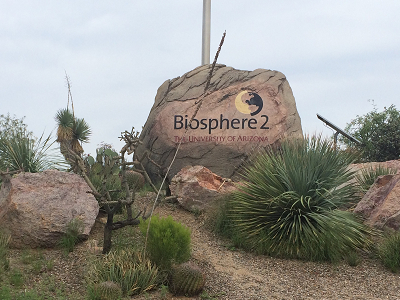
I had pre-positioned in Tucson where, after a brief deluge that was almost the only rain I’d seen, I finally got to visit Biosphere 2, which I’d wanted to see since it was built. I’d been in the area a few times doing discovery and collecting data for border crossings, but had never taken the time to stop in. Along with the perpetual sunset as I pulled into Yellowknife at midnight, it was probably the highlight of the trip.
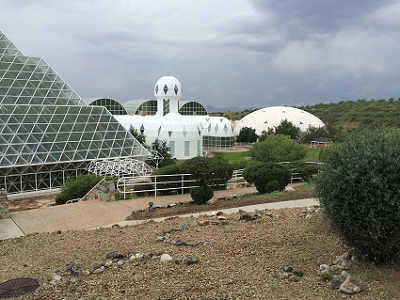
The view as you walk in from the parking lot. I’m a sucker for space frames, metal and glass, and futuristic architecture, so it had me at “Hello!”
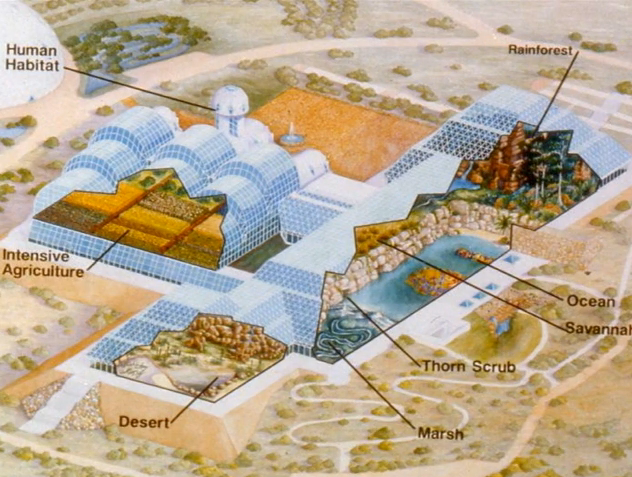

Here’s how the interior was laid out, with the five biomes, the agricultural section, and the living quarters. (Picture borrowed from this TED talk.)
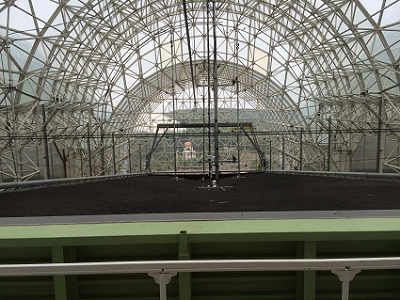

The agriculture sections have been converted to experimental bays. The movement and behavior of moisture is under investigation in this one.
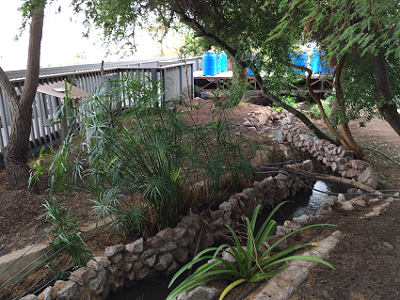

A river runs through the savanna biome, toward the desert in the background. I’m guessing this was more densely planted during the initial missions.
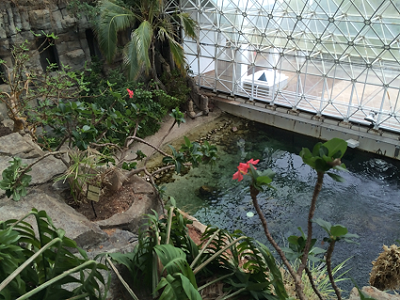

Here’s the beach end of the ocean biome.
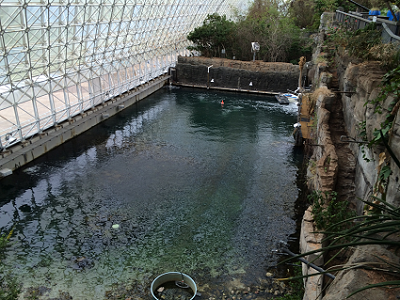

The marsh biome was at the far end of the ocean. I never got a decent picture of it from inside.
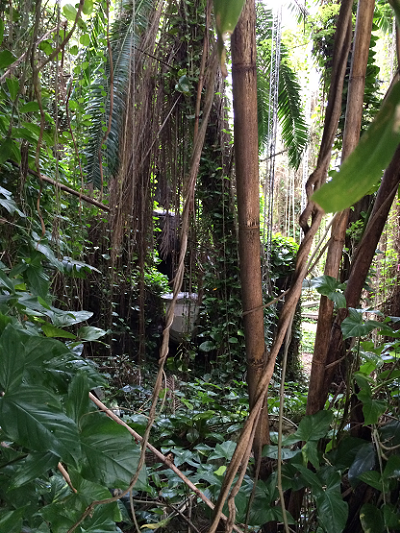

You don’t really get a feel for the space in the rather large rainforest biome, though this picture suggests that it goes on for a bit in the background. There’s a waterfall in there somewhere.
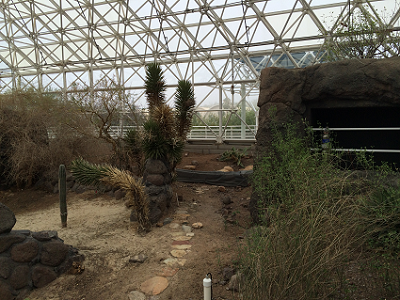

The fog desert biome looked rather different in every direction. This was my favorite angle.
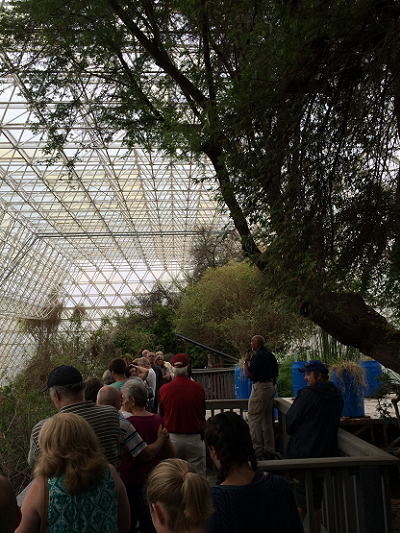

This was my favorite interior shot, which gives you a feel for the space, and has lots of that lovely metal and glass and space frame-y stuff.
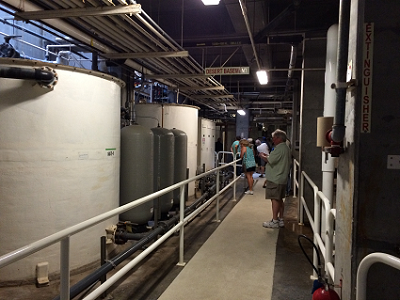

The desire may have been to create a stable interior environment where the sections interact and maintain themselves naturally, but the extant reality means that some help was needed. The tanks, pipes, valves, pumps, filters, and control hardware reminded me of all the time I spent in paper and steel mills. I was right at home down there!
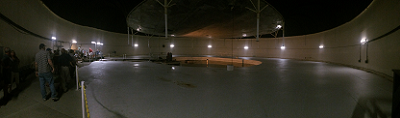

One of the most interesting features of the complex was the “lung”, a huge diaphragm that allowed the interior volume to vary so the interior pressure could equalize with the exterior pressure. Without this feature the glass window sections would be blown in or out. The diaphragm (or perhaps the entire lung enclosure) is about 180 feet across. The metal disk in the center is heavy at 16 tons and moves up and down by tens of feet. The diaphragm itself is four tons or rubber.
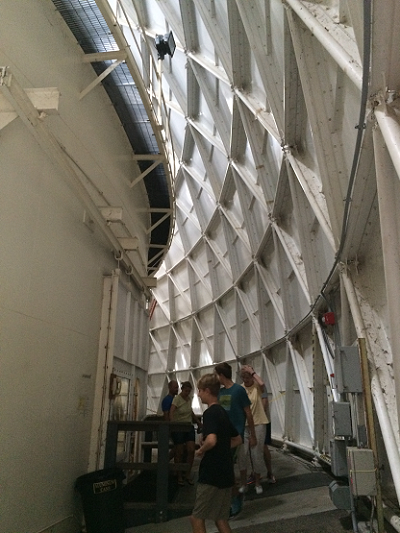

Opening the door allows huge volumes of air to escape the lung interior. You can see the disc lower significantly.
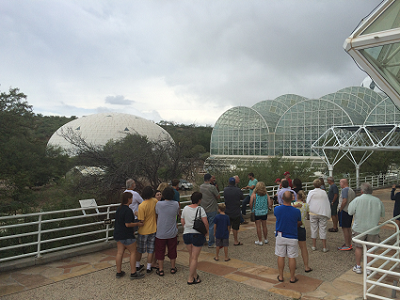

Here’s the back side of the complex and the exterior of one of the lungs. A second lung is available as a backup, but it has apparently never been used.
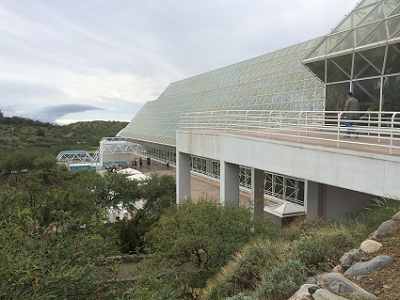

Another view along the outside. The rainforest is in the foreground and the desert in the distance.
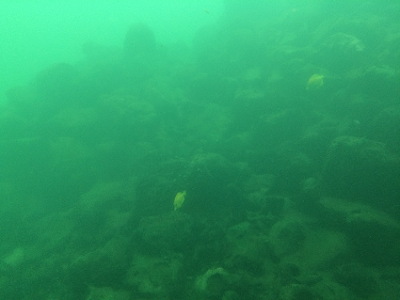

The ocean can been seen from the outside through a window. We were told that the goal is not to run an aquarium but a more natural system, thus the cloudiness of the water. Interestingly, some scuba divers were practicing for certification in the ocean during the tour.
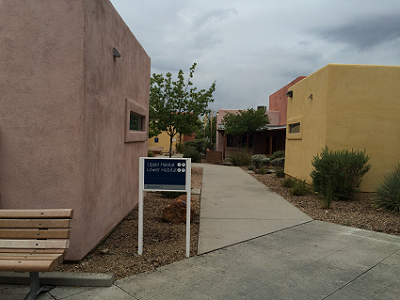

I really enjoyed the faux New Mexican adobe look of the complex of service buildings on the site. They really added to the ambiance of the place.
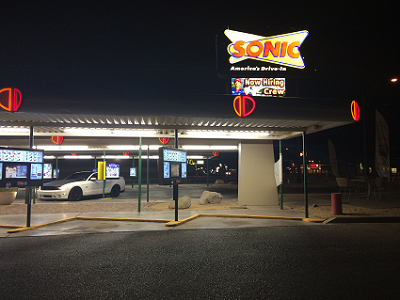

After imbibing all of Biosphere 2 I headed west to Roswell. This took me through my old stomping grounds in Alamogordo, NM. I stayed with my Army test platoon at Holloman Air Force Base on and off for several months and trained and participated in tests up north. We’d often stop at this Sonic in the evenings and I relived happy memories of chili cheese coneys and root beer floats. (I chose to pass on the onion rings…)
Posted in Life | Tagged , , | Leave a comment

Arcosanti, my old friend…

I’ve come to talk with you again…

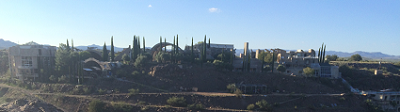
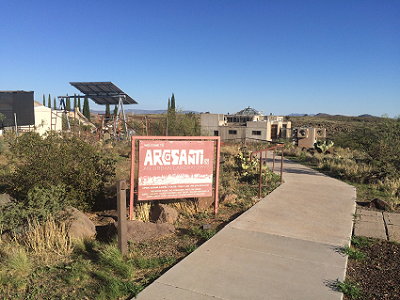
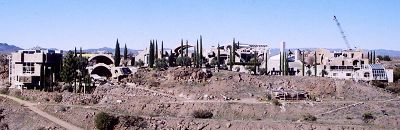
From the Grand Canyon I made it down to one of my favorite places ever, Arcosanti, in time to catch the last tour of the day. I’d made previous pilgrimages here in 1991 and 2004 and was happy to stop in again.

entrance

2004

2016

I first learned about the place in a film strip (remember those?) in Mr. Horst’s Sociology class during my junior year in high school. I can’t say I remember exactly how it was described, though I’m sure it had something to do with experimenting with different ways of having people live and work together. What really set me on fire was the visually striking nature of the architecture itself. As I learned later, designer Paolo Soleri‘s concept was called an arcology, a portmanteau of “architecture” and “ecology.”

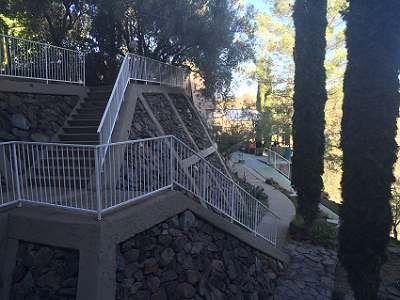
pathways

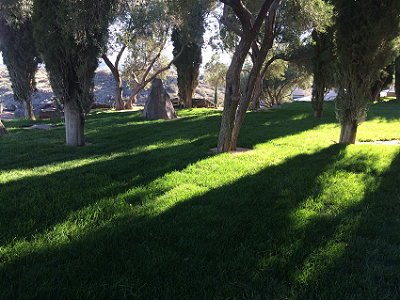
green space

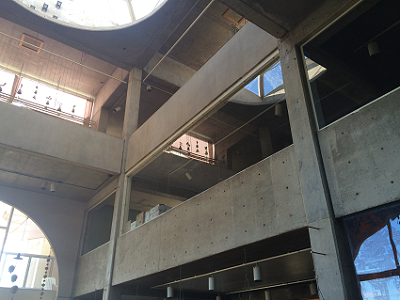
visitor center interior

His idea is to create urban spaces with high population density and low environmental footprint. The high population density is achieved by tucking large numbers of smallish living spaces together in a limited footprint. This is made interesting by creating lots of variations in spaces, levels, connections, and textures. The low environmental footprint is achieved in several ways. One is by integrating residential, commercial, and industrial activities into the same space, which reduces the need to commute long distances for work and commerce. Another is integrating passive solar and wind features into the structures themselves by using apses, vaults, thermal flywheel effects, convection guides for air movement, breezeways, and so on.

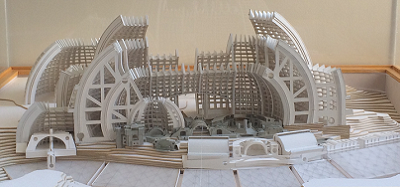
The complex is built along the top of a south-facing ridge to take advantage of the motion of the sun. This model shows the completed section of the complex in gray and the latest proposed expansion, which could support a population of 5000 (residentially at least, I’m not sure the industry would scale as well in this design), in white. The truth is that no major construction has been undertaken in at least ten years and the State of Arizona has pulled the organizations building permit. In typical fashion the extant building codes are geared towards standard construction techniques anyway, and don’t really allow for the type of work envisioned for the site.

model

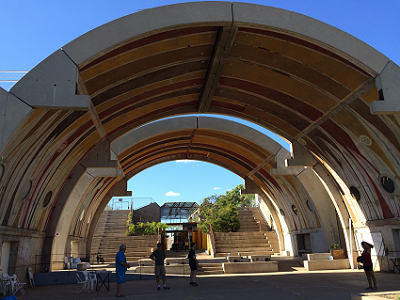
aphitheater

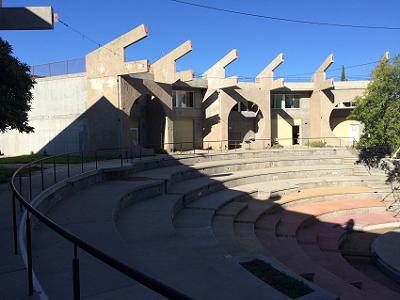
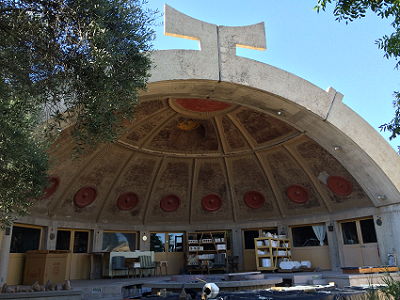
The aforementioned industry involves the casting of metal and ceramic wind chimes, which fund a respectable portion of the Cosanti Foundation’s work. The casting is done by hand in the outdoor apses using the fine sand collected from the valley floor. I believe the remainder of the funding comes from workshop fees, rentals of public and performance spaces in the main vault and amphitheater, donations, grants, public tours, and other sales from the gift shop, bakery, and cafe.

ceramic casting in apse

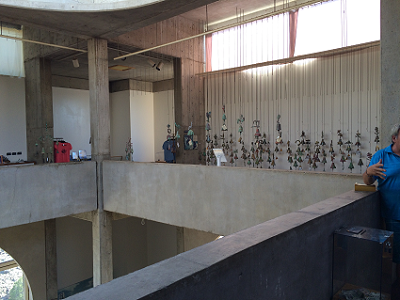
Soleri bells in the gift shop

the vaults

I have no doubt that the workshop participants, often architects, designers, and urban planners in training, get a lot out of their experiences. The ones I’ve talked to during previous visits have always been excited about the concepts and the work they got to do. The current population is in the mid-90s and includes some children. All of the adult residents work for the Foundation in various capacities under the (co-)leadership of Soleri’s successor, Jeff Stein, AIA.

The concepts explored at Arcosanti have informed research into space colonization, establishing colonies at sea, and urban design. They have been incorporated into science fiction, games, and other areas and have had a notable effect on the larger culture, so in that regard Soleri’s work has been a success. This is in contrast to the feeling some people get when visiting the site itself, which feels rather isolated, drab, run down, and kind of past it. One wonders why the founders didn’t seek investors, build the thing out, get it running, and go on and replicate the process elsewhere. If the ideas were so great then the whole program should be a rousing success, right? Well, someone might do that at some point, but the project was also the brainchild of one individual. Who can blame him for doing things the way he envisioned them, more or less on his own? On balance he made it work, and even if I might have wanted more, that’s something I can appreciate and respect.

Posted in Economy and Society | Tagged , , , | Leave a comment

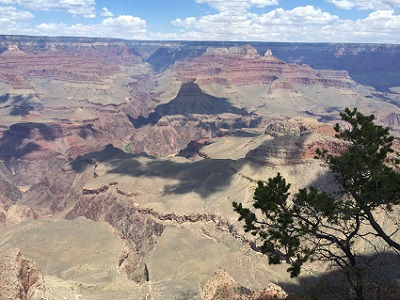
Grand Canyon

Geology is still interesting. Big time. đŸ™‚

Posted in Life | Tagged , | Leave a comment

Oakland/Berkeley/San Francisco

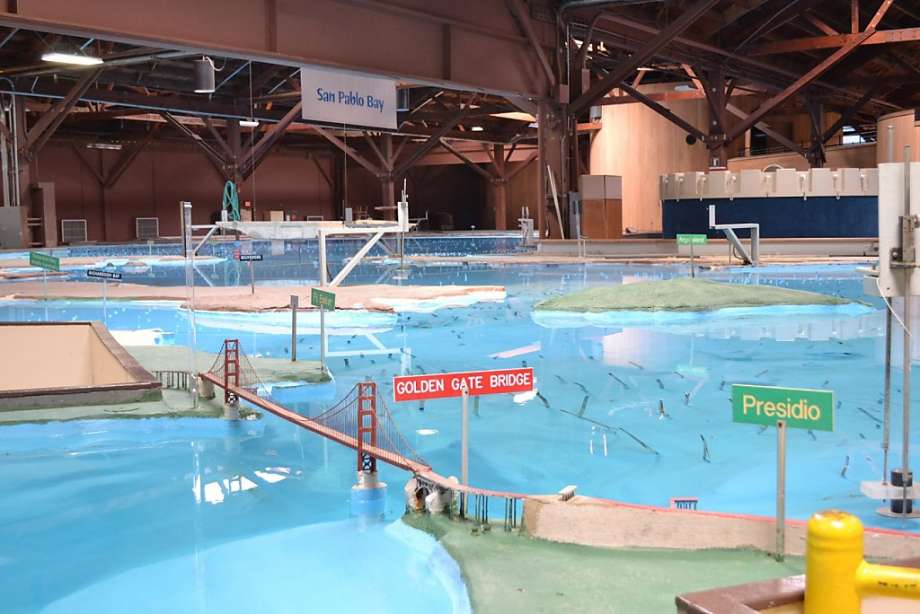
Today I stopped in to Berkeley and Oakland to see family. I didn’t actually see the Bay on this trip except a glimpse as I was coming over the hill towards upper Berkeley. I always love visiting, swing dancing, hitting Amoeba Records, hiking in the Marin headlands, and so on, but the coolest thing I ever saw in the area is the U.S. Army Corp of Engineers Bay Model on the water in Sausalito.

picture of San Francisco Bay Model

The major impression you get from the thing is that it’s big. The building is cavernous, the surrounding floor and walkways vary in height so workers (and visitors) don’t always have to bend over to reach the water in interesting places, the channels that feed the bay are quantitatively representative but are not always laid out according to the map, numerous copper fins are attached to the bay and ocean floor to help calibrate the model, and there are instruments and labels everywhere.

It was built in the 1950s to assess the feasibility of damming off the north end of the bay (with a negative result). The model is a form of analog simulator, which is not to be confused with a simulation run on an analog computer. Nowadays such investigations would be carried out using (digital) computer simulation, which renders the Bay Model obsolete for serious research. However, it remains open as an educational tool and a fascinating reminder of how really smart people did really smart things not too long ago.

Posted in Life | Tagged , , | Leave a comment

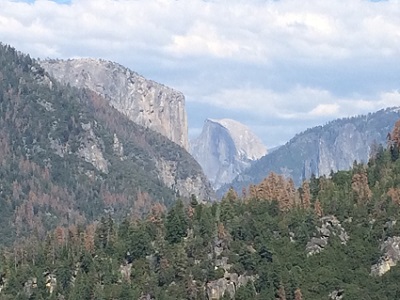
Yosemite

Yup, geology is interesting.

Posted in Life | Tagged , | Leave a comment

The Spruce Goose and Crater Lake

Transportation and engineering are cool, but geology and topography turn out to be pretty cool as well.

I rushed through the Evergreen Aviation & Space Museum in McMinnville, OR, just south of Portland, when it opened, and then hustled down to Crater Lake, which I was able to enjoy at a more leisurely pace.


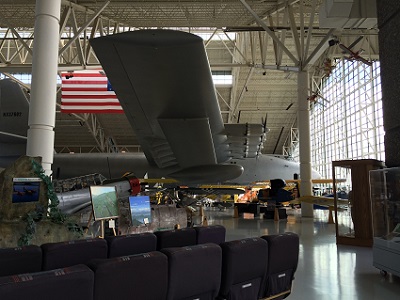
The Spruce Goose is so large it’s difficult to get a good picture of it from inside the building.


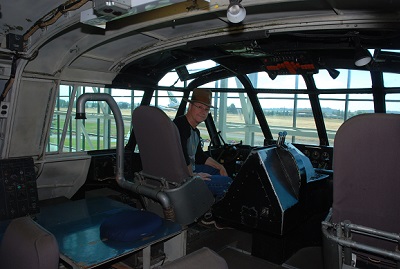
Taking the tour of the flight deck was especially impressive. I’ve ridden on a C-5 Galaxy full of heavy equipment and that was big. The Spruce Goose is bigger.


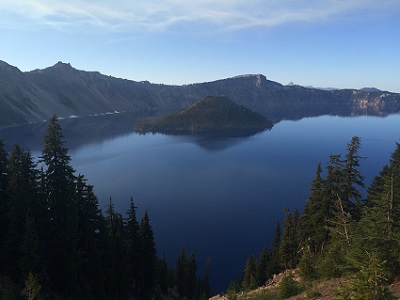
The blues are blue, the slopes are steep, there’s snow in August, and everything is right where it’s supposed to be.

In the absence of actual data I always envisioned Crater Lake as being eleven or twelve thousand feet up and only a half a mile or a mile across, but it turns out to be seven thousand feet up and five or six miles across. It looked just like the pictures, the drive around the rim road was a lot longer then I expected, and the reality was both more and less impressive than I imagined–with respect to elevation. The scenery is stunning, well worth a look.

Posted in Life | Tagged , , , | Leave a comment

Evergreen Aviation & Space Museum, Home of the Spruce Goose

Today I visited with friends and family in Seattle, got my car in for routine service (oil/filter/rotate/fluids), and pre-positioned down to McMinnville, OR, home of the Evergreen Aviation & Space Museum and the Spruce Goose. If feats of engineering and forms of transportation are going to be a theme, then I might as well make ’em interesting.

Posted in Life | Tagged , , , | Leave a comment

Hell’s Gate Airtram

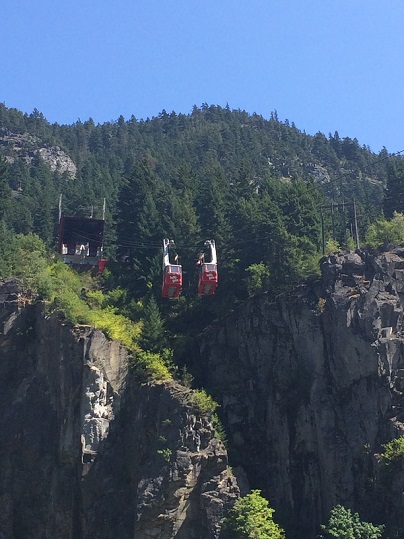
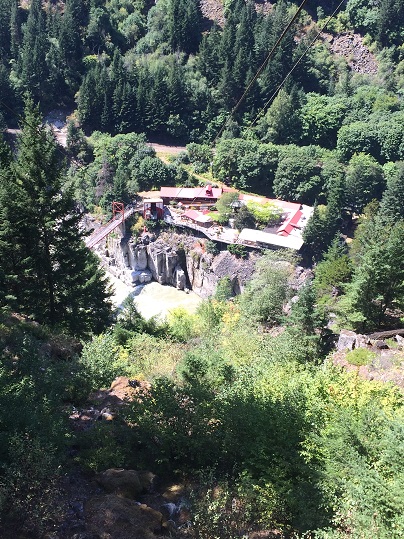
Finally dropping down out of Canada on the way to Seattle took me through a long section of the Frasier Gorge. I’m meeting friends and family in Seattle so I didn’t have to kill myself driving every minute, which allowed me to stop and check out the Hell’s Gate Airtram. I’m always into interesting scenery, feats of engineering, and forms of transportation so this was a welcome chance to relax and enjoy something different. Check the link out for details.

Posted in Life | Tagged , , , | Leave a comment

Hello, Skagway, AK

The die rolls for today’s maintenance actions came up with good numbers and progress resumed, ending in Skagway, Alaska. The Yukon was the eleventh Canadian province I’ve gotten to, and Alaska the fiftieth state. That’s enough accomplishment for one day.

Posted in Life | Tagged | Leave a comment

Hello, Fort Nelson, BC

Couple of things to report. One, the simulations of maintenance logistics I worked on with RTR Technologies, while working on and with the Aircraft Maintenance Model, incorporated a number of concepts. Many of these were defined in the NAMP (Naval Aviation Maintenance Program). Among the events considered, both implicitly and explicitly, are these:

  • Time between failure of parts
  • Availability of personnel, tools, and facilities to perform maintenance
  • Scheduled and Unscheduled Services
  • Availability of parts in local supply
  • Time of delivery for parts not in local supply
  • Time to begin work on repair (after other items in queues are addressed and sufficient personnel are available.
  • Chance that correct part is not delivered
  • Time between failure of ad hoc repair not using correct parts

There are a few additional factors in play as well, but I report these because they have become annoyingly germane in my life over the last couple of days. Nothing evil, dangerous, or particularly expensive, just annoying. Tomorrow I will execute a new set of dice rolls for a new iteration of the Monte Carlo simulation that is the automotive portion of my life, and we shall see what happens. With luck I won’t have to mention any of this again. If you need to know what this is about, check yesterday’s post–and then check a map. Then consider the human costs of things we blithely attempt to simulate using computers.

In the meantime I reworked the way that my JavaScript code handles default parameters, so the animations work correctly on a wider variety of platforms, including my iPhone.

I had experimented with statements that did the same thing in different ways, but the interpreters balked. This method is both cleaner and doesn’t cause the interpreter to puke.

Posted in Tools and methods | Tagged , , , | Leave a comment