New Technology, The Full Project Life Cycle, and Your Career
R.P. Churchill
CBAP, PMP, CSPO, CSM, A-CSDwww.rpchurchill.com/presentations/Purdue
35 Years of Simulation
|
Industries
|
|
|
35 Years of Simulation
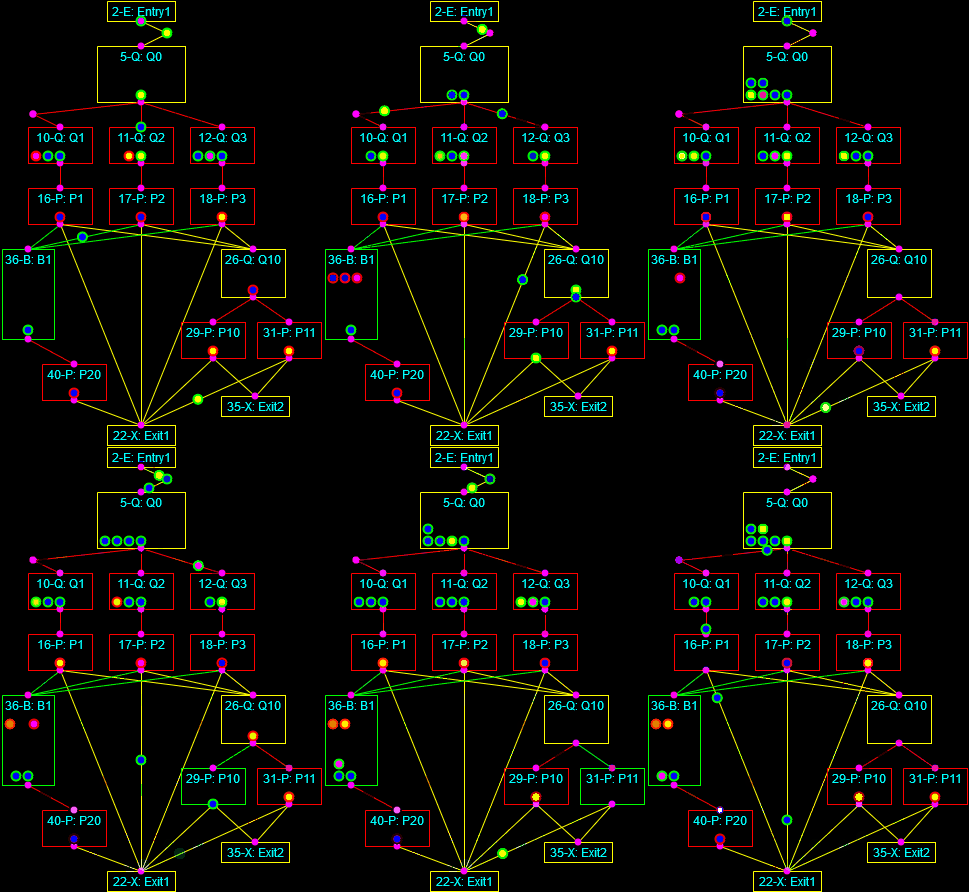
Continuous simulation of the heating of a square billet and Discrete-Event simulation of a multi-phase process.
Article from My Final College Newspaper
Your first job (probably) won't be your dream job.
It might happen under certain, limited circumstances.
I knew I wanted to be an engineer, and I later knew I wanted to integrate computer systems with that... somehow.
I actually got pretty lucky, but I also did a lot of unexpected things.
I never did any one thing long enough to be really great at it, but I ended up being great at the meta, the overall analytical skills that apply across all build and modify-type endeavors.
I loved all of it almost from day one!
In the Real World You Solve the Hard Parts

Some of the earliest physics problems you do in school omit detail.
Sometimes you canNOT assume a massless, frictionless, non-elastic- but-perfectly-flexible physics connecting device!
Imagine the anchor chain on an aircraft carrier...
Image from http://hyperphysics.phy-astr.gsu.edu/hbase/incpl.html
"Under the Hood"
You need to know what's going on in a lot of different contexts.
You can't be expected to know them all right away, but you have to start somewhere.
Your knowledge and experience will start in a limited range and will grow from there.
Here are a few things I might have wanted to know before I started...
Levels of the Computer Tech Stack
| Enterprise Architecture |
| System Architecture |
| Communication and I/O |
| Programming Language <- You are here! (probably...) |
| Assembly Language |
| Operating System |
| BIOS |
| Processor |
| Memory and Computing Units |
| Physical Logic Gates |
Most will start in the programming language level, but even that includes issues like data structures, memory management, language structure, control mechanisms, "syntactic sugar", and so on.
Then you might learn multiple computer languages, what is the same and different about them, why they were created, and more general philosophical concepts.
Process vs. Engagement vs. Solution vs. Environment

|

|
How much of any element are you a part of?
The Process (or Product) is the working system you either create or modify. The Engagement is the structured work you do to create the solution. The Solution is the change you make to the system (creation or modification). All those elements are in the Environment.
Link to detailed discussion.
The Process: Components
|
|
|
Link to detailed discussion.
The Process: SIPOC (and COPIS)

S-I-P-O-C is forward/push; C-O-P-I-S is backwards/pull.
Any number of inputs and outputs are possible.
This view allows all operations to be connected and analyzed in detail.
The Process: Station/Process Block Events

|
|
The Engagement
- Project Planning
- Intended Use
- Assumptions, Capabilities, Limitations, and Risks and Impacts
- Conceptual Model (As-Is State)
- Data Sources, Collection, and Conditioning
- Requirements (To-Be State: Abstract)
- Functional (What it Does)
- Non-Functional (What it Is, plus Maintenance and Governance)
- Design (To-Be State: Detailed)
- Implementation
- Test
- Operation, Usability, and Outputs (Verification)
- Outputs and Fitness for Purpose (Validation)
- Acceptance (Accreditation)
- Project Close
The Engagement: Simplified
 Intended Use
 Conceptual Model (As-Is State)
 Data Sources, Collection, and Conditioning
 Requirements (To-Be State: Abstract)
- Functional (What it Does)
- Non-Functional (What it Is, plus Maintenance and Governance)
 Design (To-Be State: Detailed)
 Implementation
 Test
Test- Operation, Usability, and Outputs (Verification)
- Outputs and Fitness for Purpose (Validation)
The Engagement: Communication Models

There are multiple barriers to clear communication.
These can be mitigated by error-checking mechanisms — and by being clear in the first place.
The end blocks can be improved by review, mutual expertise, patience, and empathy.
The middle blocks can be improved by clearing up the communication medium.
The Engagement: Working Together Means Having Conversations

- Work is rarely completed successfully on the first try.
- You should think of (any kind of) work as a conversation where the back-and-forth continues until all parties understand and agree...
- ...ideally, sometimes you need to cut things off and move forward.
- You can often revisit conversations when more is learned or conditions change.
- I represent a conversation as a loop with a standard entry and exit shown moving left to right at the bottom. This shows the normal flow of work moving forward.
- An additional entry and exit are shown at the top, moving backward from right to left. This illustrates the capability of revisiting prior work to make additions, deletions, or modifications.
The Engagement: Customer Feedback Cycle
Review every phase with the customer until they agree it's correct, especially for the Conceptual Model (As-Is State).
Needs discovered later could require the creation or modification of earlier elements.
This framework is usable for both Waterfall and Scrum, and really for any management style.
Link to detailed discussion.
The Engagement: Phases May Have Multiple Sub-Levels
Examples
- Conceptual Model (Discovery & Data Collection at nuclear plant)
- Discovery: Review of hardware (determine what parts are needed)
- Data Collection: collect control panel readings
- Discovery: Analysis to determine internal system states
- Discovery: Analysis to determine governing equations
- Planning
- Project Management (Charter, Resources, etc.)
- Business Analysis
- Project Close
- Design (Application Layers)
- Business Information (Abstract)
- Code / Data / Communication / UI/UX
- Hardware / Environment (OS) / Networking / Security
- Implementation (Experiments / Build / Deployment & Training)
- Development (Standalone Components)
- Integration (& Test) (System Level)
- Implementation (Deployment / Turnover)
The Engagment: Context


|
|
Link to detailed discussion.
The Engagement: Context (continued)


|
|
Link to detailed discussion.
The Engagement: Requirements Traceability

- Ideally, all elements should map in both directions across all phases.
- Relationships can be one-to-one, one-to-many, and many-to-one.
- Tracing can be done across phases (horizontally) and heirarchically within the design (vertically). All elements should align in the design phase.
- Doing this ensures you do everything you need to do to address the stated problem, and that you don't do things that are not needed to address the stated problem.
Link to detailed discussion.
The Engagement: Extended Life Cycle

The close of an engagement that builds something new only hails the start of managing the full life cycle.
Engagements that modify an existing system have only the six core phases.
Ongoing projects and programs may effectively never have a closing phase, but this usually only applies to in-house efforts.
Work performed for third parties usually has a defined endpoint.
The Engagement: Bob vs. the SDLC

The SDLC phases are a little jumbled, in my estimation.
But if you consider the iteration between phases, and the fact that nothing ever really happens in a formal, fixed order, you can see that all the pieces are there.
The Process: Know What's Coming and Plan Accordingly
It is EXTREMELY important to understand the structure of an engagement before beginning one.
This involves being aware of and provisioning for every activity that needs to be completed for a successful effort.
Participants in different roles will be concerned with different things, but all must be able to work together in a shared context.
Participants never want to be surprised that something needs to be done. The design and implementation phases will generate all the surprises anyone needs. Don't let surprises happen during the engagement management process.
The Solution
The solution is the change made to serve customers, whether it means building something new or modifying something that already exists.
|
|
These approaches are not mutually exclusive.
Link to detailed discussion.
The Solution: Tradeoffs
List of considerations
|
Computing
|
People and Methods
|
Cost
|
The ultimate optimization is to minimize the total cost of ownership over the entire life cycle.
The Environment
The environment is what supports the team members and the work. If the environment is wrong, how can the work be right?
The proper environment should support:
- Effective onboarding and training to get new hires integrated and up to speed
- Strong and open communications, both formal and informal
- Effective management practices shepherded by people who truly understand them
- Active communities of practice
- Allowing and inspiring people to do their best work and not just socializing over a foosball table
- Understanding that all work is iterative, which allows people to experiment, learn, grow, and make (and recover from) mistakes
- Formal and informal support for ongoing training and certification
The Environment: Management Practices
Practitioners should understand the underlying theory of each framework, and not treat the formal documentation as holy writ.
The Wikipedia article for every management practice seems to include a section for criticism. The criticism is essentially always the same, that following the specified steps doesn't by itself lead to the desired outcomes. This is because all the management guidance is more about art than science. You have to get beneath what is written.
Managers are sometimes also contributors, but managers should understand that their primary goal is to make others great, and not necessarily themselves.
Professional management is more about preventing bad outcomes than shooting for optimal ones. Creating the right environment gives the best chance for greatness to happen.
Technological Life Cycles
|
The Tech Arc
Detailed information here. |
The Industry Arc
Examples include shipping, railroads, textiles, automobiles, radios, televisions, solid state electronics, and computers. AI is only the most recent one. |
Summation
You begin your career knowing a little about a few things, and grow outward in many contexts.
Communication is critical, iterative, and ongoing.
The major working contexts are the Process (or the Product), the Engagement, the Solution, and the Environment (at least for me).
Those things largely apply in every industry, and piggyback on knowledge specific to each industry.
First you learn to contribute. Then you learn to team. Then you learn to serve.
Many considerations must be balanced.
What is important and popular today will be less so tomorrow. There will always be something new. You can always go wider and deeper.
Never stop learning.
This presentation and other information can be found at my website:
E-mail: bob@rpchurchill.com
LinkedIn: linkedin.com/in/robertpchurchill